

Developing a Market-Based Compensation Philosophy
by Beth Carroll

Not surprisingly, I’m having many conversations about the Measure Up survey data and how it should be used in practice. A prior article covers some basic statistics so it may be helpful to read this one first.

Two common questions are “where should we be” and “what do we do if our data is ‘off’ of what the survey shows it should be?”
Where Should We Be?
This is a heavily philosophical question with deeply practical implications.
First, a brief hierarchy of importance when looking at Total Compensation stats vs Salary Stats. Always start with Total Comp. Freight brokers are an incentive heavy lot, but not everyone uses incentives the same way. There are many companies in our set that pay Carrier Sales, Hybrid 1, and Hybrid 6 using ZERO salary. They may get a draw, or they may not once they are “on commission.” This is why you may see salary numbers DECREASE for higher experience levels, because a number of incumbents are reported at zero.
There are also companies who pay very little in incentive compensation to these same roles and skew more salary heavy.
I’ve worked with a lot of industries and never seen one with such disparate approaches to pay for the same roles - both in amount and in how the pay is delivered.
Therefore, the safest stat to begin with is Total Comp as it will capture the full pay, regardless of how it is delivered. Think of the base salary as the minimum required, and the total comp as the point of differentiation. A perfectly valid compensation philosophy positioning statement would be:
We match salary to the market 50th percentile, and total compensation to the market 75th.
This would mean your median performer would be exceeding the market median in total comp, and your high-end performers would be above that. Keep in mind that your data is a range, just like the market, and you can be “at market” with a variety of different pay levels, as follows:
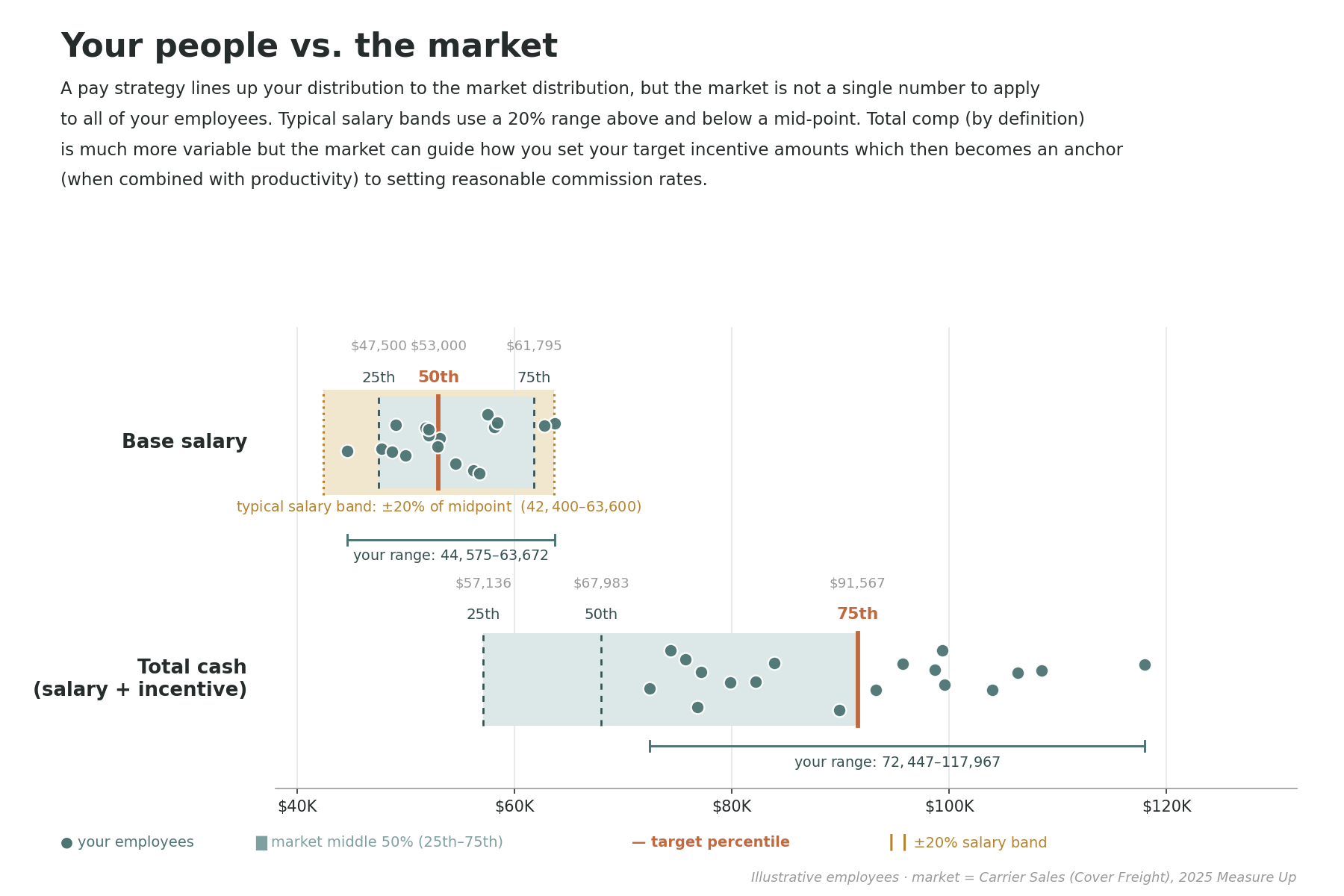
For the salary view, you’ve set your salary mid-point at the market, but the 20% range around the mid-point means pay as low as $42,400 and as high as $63,600 is safely within your salary band. The market data lets you know that $42,400 may be too little to attract and retain talent, so from a practical standpoint you may not want to bring in anyone with a salary less than $47,500 even though your band allows it.
For the total comp view, you have earners below the 75th percentile market target you selected, and you have earners above (some well above), but your internal median is landing very close to the market 75th. Good job! This is what it means to be benchmarking to the market. It does NOT mean everyone in this role makes exactly $91,567. What is more important is: are the high earners creating more profit for the company than the lower earners? Not in raw dollars (I would hope so) but in percent. A well designed incentive plan (or in truth, any plan that uses a salary) has a declining cost of compensation at higher production levels because the salary does not (and should not) be proportionally linked to production. There are also ways to design the commission plans so you enhance the effect - pay more for high performance, but as a % of production - pay a reducing percentage at target performance. We will get into more of these details in our upcoming webinar series: www.prosperiogroup.com/connect.
What do we do if our data is “off”?
This is a more complex question and one that should be addressed carefully. First, define “off” in the context of the preceding section. A few people are “off” or everyone is “off”? Where does your median land relative to the market?
Remember to always start with Total Compensation (not salaries). If you are aligned with the market for Total Compensation, you may be ok if your salaries are a tad below market. You also have to consider the impact of benefits - if you pay a higher percentage of employee healthcare, that is a true offset to lower salaries. Conversely, if you pay nothing toward healthcare, then your salaries may look higher than the market but they must be to provide a competitive total rewards package.
Increasing salaries (or commission rates) is the easy psychological change - rarely do employees complain when these changes happen. The converse is much more difficult and, frankly, not recommended unless there are extreme circumstances. Reducing salaries NEVER ends well and should only be done as a last resort, and usually with a reduction in hours rather than simply saying we are planning to pay you less for the same amount of work. Employers may want to increase motivation by reducing salary and putting the dollars toward incentive compensation, but this inevitably backfires (I’ve seen this firsthand). What you get is a demoralized and distrustful workforce, not a motivated one.
Kink the Curve Instead
In fact, the better motivational incentive design moves the OPPOSITE direction. Raise salaries. Remove any portion of the incentive that functions as “phantom base salary” and make the leverage or upside in the plan even more meaningful so the dispersion in pay between your 90th percentile earner and your 50th percentile earner INCREASES.
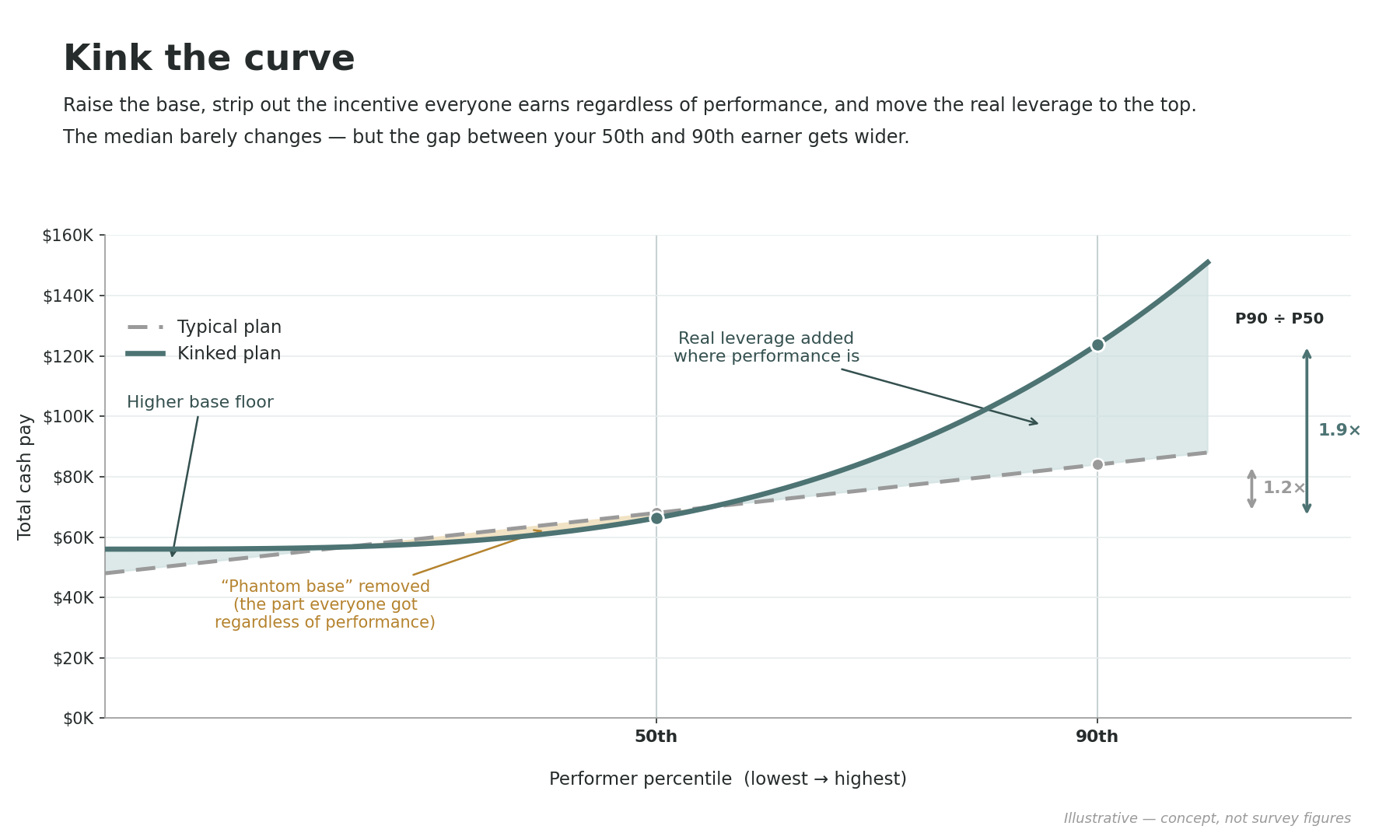
I know it’s counterintuitive, but raising base salaries can actually help you unlock more motivation from your incentive plan. One of the primary challenges with commission-only (or draw) models is they have no or limited ability to increase leverage as the plan is too leveraged from the start. A draw model requires a higher commission rate, that then cannot be meaningfully increased at higher performance levels without damaging company economics. Raising the salary and reducing the starting rate allows you to increase the rate paid for higher production, which creates more motivational reward for getting to the higher production (for everyone).